Business owners can lose thousands of dollars annually by choosing the wrong tax structure from the beginning. Others end up paying additional self-employment taxes they might not otherwise have had to pay. Some face challenges with payroll rules, reporting requirements, or complex filing procedures in the future. Problems often begin when people choose between an LLC and an S-Corp without understanding how the tax treatment actually works.
Both LLCs and S-Corporations provide the benefits of limited liability and pass-through taxation, but they do so in different ways. One option may be easier to operate on a daily basis, while the other may provide greater tax savings over time, depending on the business’s income and goals.
The best choice should not be based on mainstream opinions or trending advice found online. It should be based on your profit margins, payroll management, compliance responsibilities, and long-term plans for the company.
Understanding the details of LLC and S-Corp tax filing helps business owners reduce unnecessary taxes, strengthen their financial position, and maintain better control over operations in the long run.
What Is an LLC Tax Filing?
Filing LLC taxes involves filing taxes for your business as a Limited Liability Company. By default, single-member LLCs are generally treated as sole proprietorships, while multi-member LLCs are generally treated as partnerships unless the owners make a different tax election with the IRS.
LLCs offer:
What Is S-Corp Tax Filing?
S-Corp tax filing is a special election with the IRS that allows qualifying businesses to use pass-through taxation and potentially reduce self-employment taxes. S-Corps are not a separate type of legal business entity. An LLC or a regular corporation can elect S-Corp tax treatment by filing IRS Form 2553.
S-Corp taxation includes the following:
S-Corp setups often help companies that earn steady profits and want opportunities to reduce payroll-related tax costs.
How LLC Tax Filing Works
LLC taxation remains one of the most flexible options for small businesses. How taxes work depends on who owns the business and whether any special IRS elections are in place. In many cases, LLC profits flow through to the owner’s personal tax return.
Single-Member LLC Taxation
Single-member LLC income is normally reported on the owner’s personal tax return on Schedule C.
Multi-Member LLC Taxation
Multi-member LLCs usually file partnership tax returns and distribute profits to each member using Schedule K-1 forms every year.
Self-Employment Taxes Apply Fully
LLC owners typically pay self-employment taxes on business profits, which cover Social Security and Medicare contributions each year.
Flexible Tax Election Options
LLCs can also elect S-Corp or corporate taxation later if business growth creates better tax advantages.
How S-Corp Tax Filing Works
S-Corp taxation separates owner compensation into salary and profit distributions. This structure can reduce self-employment taxes but also adds payroll responsibilities and compliance requirements for owners operating growing businesses with steady profits.
Owners Must Receive Salaries
S-Corp owners who work in the business need to receive reasonable salaries through a proper payroll system on a regular basis.
Additional Profits Become Distributions
Profits remaining after salaries can be paid as distributions, which may lower self-employment tax exposure for qualifying businesses.
Payroll Compliance Becomes Mandatory
S-Corp businesses need to manage payroll taxes, employee reports, payroll filings, and payment requirements throughout the year.
Separate Tax Filings Are Required
S-Corps must file their own tax returns each year and maintain accurate financial and operational records to support compliance.
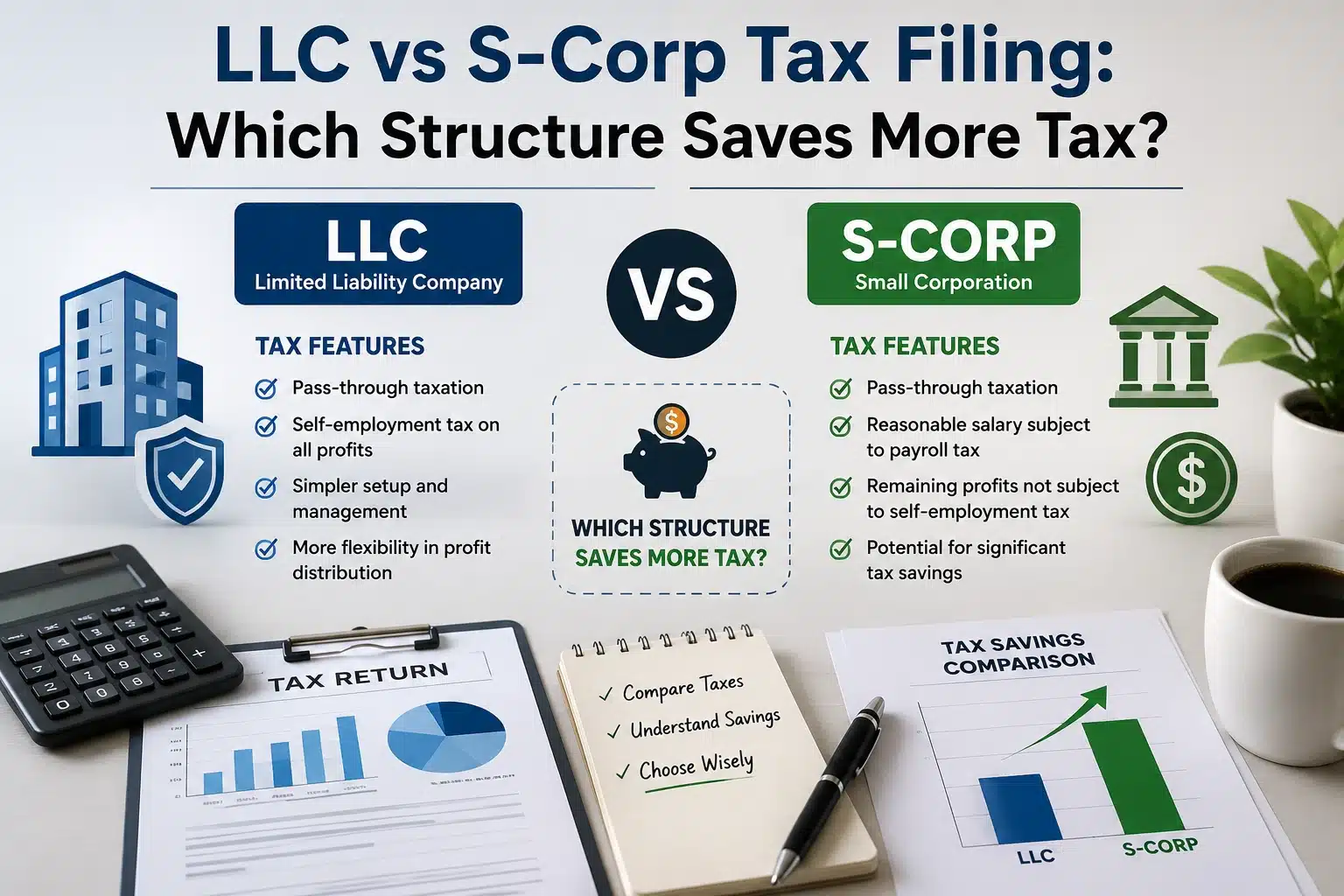
LLC vs S-Corp: Key Differences Between Structures That May Save More Tax
Choosing between LLC and S-Corp taxation depends on the complexity of your operations, profit levels, payroll needs, and future financial plans. Understanding the main tax differences helps companies choose a structure that may support stronger profits and reduce unnecessary costs.
Self-Employment Tax Treatment
LLCs generally pay self-employment taxes on their business profits each year. S-Corp owners pay payroll taxes on their salary, while additional profits may be distributed separately. This difference can create meaningful tax savings for profitable businesses using S-Corp taxation over time.
Payroll Requirements
Standard LLC taxation does not require payroll unless the business has employees. S-Corp owners who work in the business must run salaries through payroll, manage withholding, and comply with applicable IRS reporting requirements.
Compliance and Administrative Complexity
LLCs usually require simpler recordkeeping, reporting, and day-to-day compliance for smaller operations. S-Corp taxation adds payroll management, compensation documentation, additional reporting, and separate tax filings. Owners should determine whether the potential tax benefits justify the additional administrative work before switching.
Profit Distribution Flexibility
LLCs offer greater flexibility in how profits are divided among members under the operating agreement. S-Corp distributions generally need to align with ownership percentages. Businesses that require customized profit-sharing arrangements may prefer LLC taxation for greater long-term flexibility.
Tax Savings Potential
Businesses with lower profits may not gain much from switching to an S-Corp after considering payroll and compliance costs. Companies with higher profits may save more because certain distributions can reduce self-employment tax exposure and support more effective tax planning.
Operational Simplicity
LLCs are often easier for freelancers, consultants, startups, and small businesses that value simple day-to-day operations. S-Corps require stronger systems because payroll, filings, compensation management, and compliance generally involve more administrative work than standard LLC taxation.
Long-Term Business Growth Planning
Companies expecting strong profit growth should review their tax structure regularly. LLC taxation may work well during the early stages, while switching to S-Corp taxation later may provide additional tax benefits. Good planning matters because income, payroll requirements, and operational complexity can change as the business expands.
When Is an S-Corp an Ideal Choice?
S-Corp taxation can work well for businesses that generate steady profits throughout the year. Companies looking to reduce payroll tax costs may realize greater savings once they move beyond the early startup stages.
S-Corp taxation may work well for:
Businesses generating higher annual profits
Owners seeking self-employment tax reduction
Companies maintaining organized payroll systems
Businesses planning long-term operational growth
Owners comfortable managing additional compliance responsibilities
S-Corp setups often provide better tax benefits when profits are high enough to justify the additional payroll and administrative requirements.
When Is LLC Tax Filing the Ideal Choice?
LLC taxation remains popular because of its flexibility, simpler compliance, and easier financial management for growing businesses. Many startups and small businesses initially use LLC taxation before considering more advanced tax structures.
LLC taxation may work best for:
Freelancers and consultants
Startups with lower profits
Businesses prioritizing operational simplicity
Companies seeking to avoid payroll complexity
Owners wanting flexible management structures
LLCs usually offer simpler recordkeeping, less compliance pressure, and strong flexibility for smaller businesses during the early stages of growth.
LLC vs S-Corp: Key Summary
| Factors | LLC | S-Corp |
|---|
| Self-Employment Taxes | Higher | Potentially Lower |
| Payroll Requirements | Simpler | Mandatory |
| Compliance Complexity | Lower | Higher |
| Administrative Costs | Lower | Higher |
| Profit Distribution Flexibility | More Flexible | Restricted |
| Tax Savings Potential | Moderate | Higher for Profitable Businesses |
| Best For | Small Businesses | Growing Profitable Businesses |
Conclusion
Many businesses lose money each year because their tax structure no longer fits how much they earn or how they operate. Some pay high self-employment taxes. Others deal with payroll errors, compliance issues, weak tax planning, and difficult filings that create stress during important growth periods.
Deciding between LLC and S-Corp taxation should never rely on guesses or random advice from the internet. If you are looking for an expert to assist you in choosing a reliable tax structure, Kaya Tax & Bookkeeping Services, Inc. is your one-stop tax consulting firm. As a leading tax, accounting, and business consulting firm, we specialize in helping business owners choose the right structure and maximize potential tax savings.
Our team of experts works closely with business owners to help maintain compliance while supporting long-term financial success. Contact us today to get started.