Kaya Tax & Bookkeeping Services

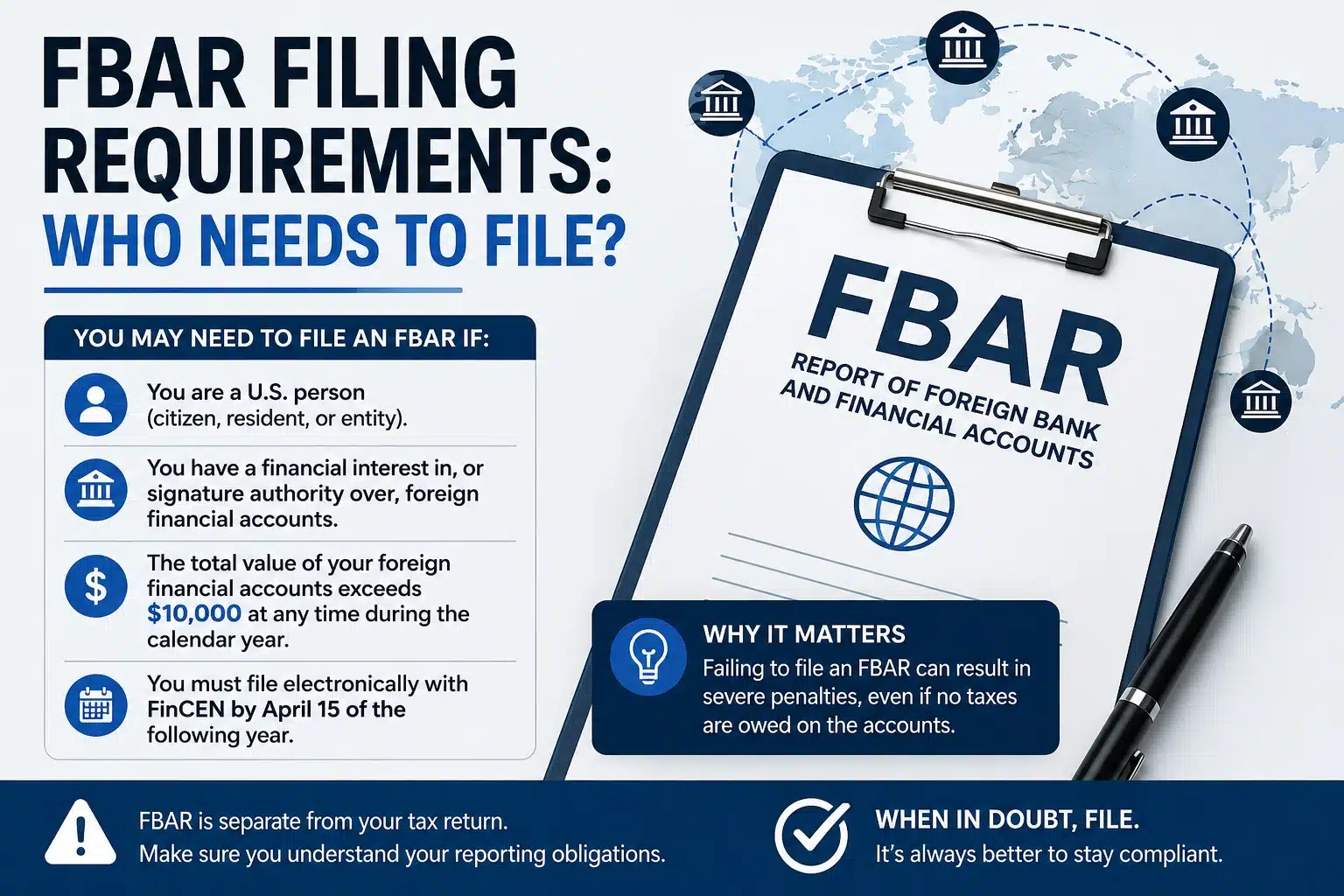
Many U.S. taxpayers are surprised to find that reporting foreign income and reporting foreign financial accounts are two separate requirements.
All those with foreign bank, investment, or other financial accounts are required to file a Report of Foreign Bank and Financial Accounts (FBAR). This is needed even if the accounts generate little or no income. If you fail to comply, you may face heavy penalties.
Learning the FBAR filing rules matters a lot for U.S. citizens, residents, and certain organizations with interests in overseas accounts.
What Is an FBAR?
The FBAR is an information report that is submitted to the U.S. Department of the Treasury’s Financial Crimes Enforcement Network (FinCEN). It is not considered a tax return, and it does not create any additional tax liability.
The main goal of the FBAR is to help the U.S. government identify foreign financial accounts owned by U.S. persons and improve compliance with international financial reporting rules.
The FBAR is filed electronically via FinCEN Form 114.
Who Needs to File an FBAR?
Typically, a U.S. person is required to file an FBAR if:
- They are a U.S. citizen, a U.S. resident, or a certain U.S. entity.
- Have a financial interest in or are in charge of a foreign financial account.
- The total value of all foreign financial accounts is more than $10,000 at any time during the calendar year.000, which may require filing an FBAR.filing an FBAR.
This limit looks at the total value of all qualifying foreign accounts, not at each account individually. For example, if someone holds three foreign accounts with balances of $4,500, $3,000, and $3,000, the total exceeds $10,000, which may require filing an FBAR.
What Accounts Must Be Reported?
Many taxpayers believe FBAR reporting applies only to foreign bank accounts. In truth, several types of foreign financial accounts may need to be reported.
These can include:
- Foreign checking accounts
- Foreign savings accounts
- Foreign investment or brokerage accounts
- Foreign mutual fund accounts
- Certain foreign retirement accounts
- Other foreign financial accounts maintained outside the United States
Important FBAR Filing Rules
Aggregate Account Value Matters
The $10,000 limit is based on the highest total value of all foreign financial accounts for the year.
Joint Accounts May Require Reporting
People who share ownership of foreign accounts may still be required to file an FBAR based on their own circumstances.
Authority Can Trigger Filing RequiSignature rements
Someone might need to file an FBAR even without owning the account if they hold the power to manage or direct what happens in it.
FBAR Is Separate From Tax Returns
The FBAR is filed separately from federal income tax returns and follows its own set of reporting rules.
When Is the FBAR Due?
The FBAR normally comes due on April 15 each year following the reported calendar year. An automatic extension usually runs until October 15, so most taxpayers do not need to request a separate extension.
Conclusion
FBAR reporting rules are often more complex than many taxpayers realize, especially when there are multiple foreign accounts, shared ownership arrangements, or questions about signature authority. Understanding whether or not you need to file is a crucial part of your financial reporting compliance with the U.S. financial reporting requirements.
Looking for a taxation expert who can align with FBAR Filing requirements? KayaTax & Services is the way to go. We have a team of taxation experts offering tax preparation, tax consultation, bookkeeping, and accounting solutions for businesses and individuals, helping them stay organized and compliant with tax and reporting requirements year-round.
What Our Clients Say About Kaya Tax & Bookkeeping Services
Join hundreds of individuals and businesses who trust us for financial clarity and smarter decisions.

I've been working with them on my tax returns for a few years now, and they consistently do a great job. They also send so helpful updates every week. Hakan is a truly polite and understanding gentleman. Thank you for everything!
Ezgi Ö.
These guys have always been great! They are knowledgable, kind and give you the time. I have never felt rushed or that any of my questions were silly. They are affordable and are very close to my house. I would recommend them definitely. The lady at the front desk is also really helpful and kind, she always picks up and gets your question answered. The whole office is great. My friend recommended them to me and I can see why.
Ike e.
We're so delighted to hear you enjoyed our service! Your support warms our hearts ❤️ If there's anything else we can do, please feel free to reach out anytime. Wishing you all the best and we hope to serve you again soon!
S. Pichs
We're deeply grateful for your kind words! 😊 It's fantastic that our team could assist you with your complex tax needs. Thank you for trusting us and recommending our services. We're looking forward to supporting you with all your future tax requirements.
A. Basar
Hi, I would like to share my wonderful experience of book keeping services with KAYATAX, which is really an amazing service and helpful in providing my business a skilled and reliable service. So I would highly recommend you to join KAYATAX services of bookkeeping in order to enhance your business.