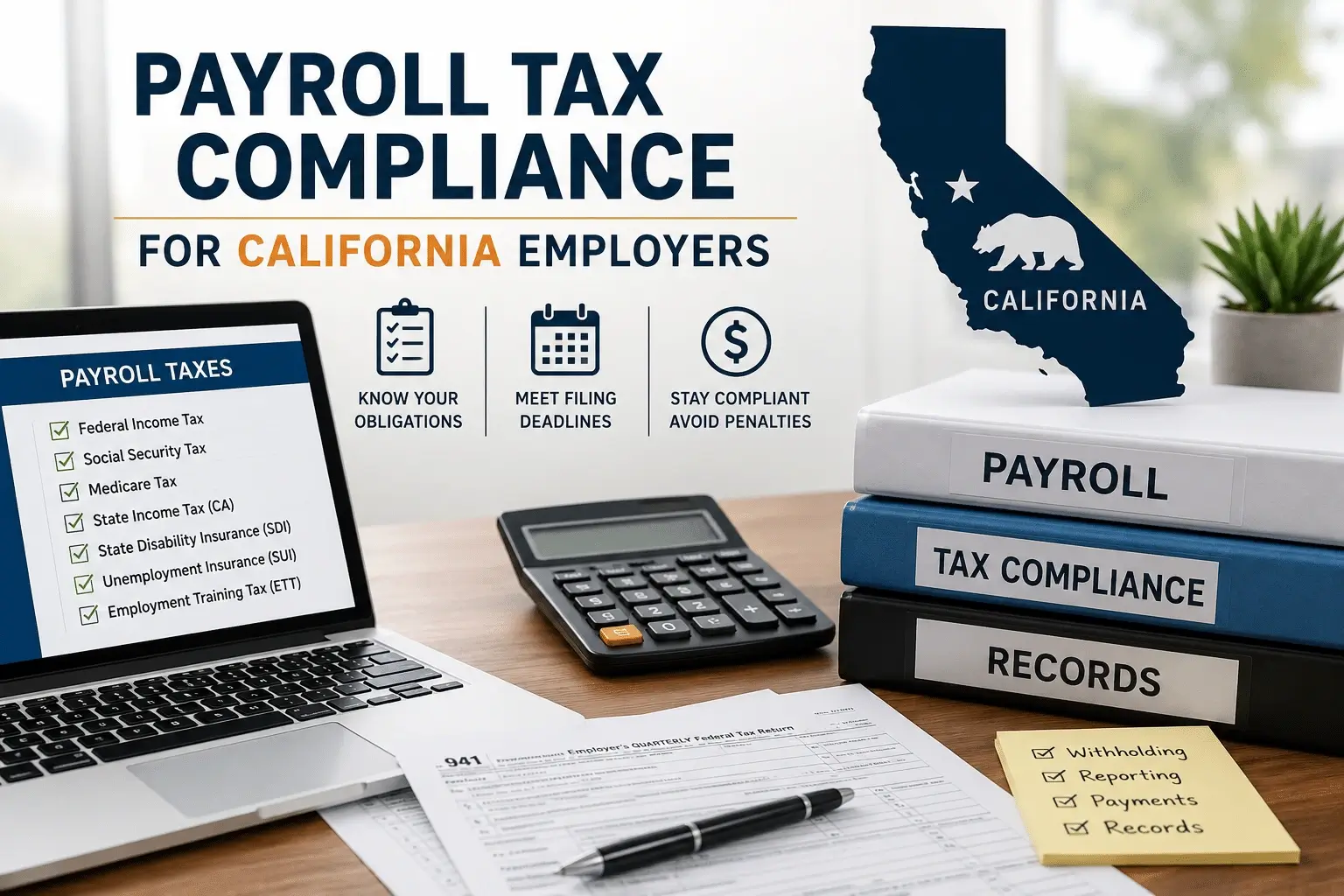
Payroll tax compliance can be challenging in California. Employers have to manage strict filing deadlines, numerous tax requirements, frequently changing rates, and significant penalties for mistakes. Even small payroll errors can trigger audits, result in tax notices, cause employee disputes, and increase expenses that negatively affect a company’s bottom line.
Payroll is a challenge for many California businesses because the requirements can be significantly more complex than federal requirements. Employers must calculate taxes correctly, maintain proper employee records, submit required reports, and comply with Employment Development Department regulations throughout the year.
This guide covers payroll tax compliance requirements in California, common mistakes employers make, required filings, and important steps businesses can take to avoid payroll tax problems.
About California Payroll Tax Compliance
California payroll tax compliance is the legal obligation of an employer to manage employee compensation, make required deductions, complete reports, and submit payroll tax payments.
California has its own payroll tax laws in addition to federal payroll tax requirements. Most state payroll tax rules are administered by the California Employment Development Department (EDD). Employers must report wages, withhold applicable taxes, calculate payroll taxes, and remit required payments in accordance with state regulations.
Failure to comply can lead to:
- Late payment penalties
- Interest charges
- Payroll audits
- Employee wage disputes
- Tax notices
- Increased unemployment tax rates
- Business cash flow disruptions
As businesses grow, hire more employees, open new locations, or employ remote workers, California payroll compliance can become more challenging.
California Payroll Taxes Employers Must Handle
Most California businesses have to manage four primary state payroll taxes.
Unemployment Insurance (UI)
Unemployment Insurance is an employer-paid tax that helps fund benefits for eligible workers. The EDD sets a UI tax rate for each employer. New employers often begin with a standard rate, while established employers may receive rates based on their unemployment claim history. The UI taxable wage limit applies only to the first specified amount of each employee’s wages each year.
Employment Training Tax (ETT)
The Employment Training Tax supports worker training programs throughout California. ETT is paid by employers and applies to taxable wages. Although the ETT rate may be relatively low, employers must still ensure that it is reported and paid correctly.
State Disability Insurance (SDI)
State Disability Insurance is withheld from employee wages. California’s SDI program provides temporary disability and paid family leave benefits to eligible workers. The SDI withholding rate may be updated periodically based on state requirements. In recent years, California removed the SDI taxable wage limit, meaning applicable wages are subject to SDI withholding.
California Personal Income Tax (PIT)
California employers must withhold state personal income tax from employees’ wages using applicable withholding tables and the information employees provide on required forms.
Incorrect PIT withholding can create significant compliance problems because underwithholding may leave employees owing additional taxes and may also result in problems for the employer.
Important California Payroll Forms Employers Must File
California employers need to submit several payroll-related forms throughout the year.
DE 9
The Quarterly Contribution Return and Report of Wages reports wages paid and payroll taxes due for each quarter.
DE 9C
The DE 9C reports wage information for each employee every quarter.
DE 34
California employers must report new hires using Form DE 34 within the required reporting period.
DE 88
Form DE 88 is used for payroll tax deposits involving:
California requires employers to make payroll tax deposits according to their assigned deposit schedules.
California Payroll Tax Filing Deadlines
California employers must meet payroll tax filing deadlines established by the California Employment Development Department (EDD). Failure to meet applicable deadlines may result in penalties, interest, compliance notices, and other tax problems.
| Filing Requirement |
Form Name |
Filing Frequency |
Due Date |
| Quarterly Payroll Tax Return |
DE 9 and DE 9C |
Quarterly |
April 30, July 31, October 31, January 31 |
| New Employee Reporting |
DE 34 |
Within 20 days of hiring |
Ongoing requirement |
| Independent Contractor Reporting |
DE 542 |
Within 20 days of payment or contract |
Ongoing requirement |
| Monthly Payroll Tax Deposits |
DE 88 / e-Services Deposit |
Monthly |
15th of the following month |
| Federal Quarterly Payroll Return |
IRS Form 941 |
Quarterly |
April 30, July 31, October 31, January 31 |
| Annual Federal Unemployment Return |
IRS Form 940 |
Annually |
January 31 |
| Employee Wage Statements |
Form W-2 |
Annually |
January 31 |
| Independent Contractor Forms |
Form 1099-NEC |
Annually |
January 31 |
Common Payroll Tax Compliance Mistakes California Employers Make
Many payroll problems begin with basic day-to-day errors.
Misclassifying Workers
Worker classification mistakes can create serious payroll tax problems. Businesses sometimes classify employees as independent contractors when they should be treated as employees. California has strict worker classification standards, so proper classification is essential. Incorrect classification can result in unpaid payroll taxes, unpaid wages, penalties, and audits.
Missing Payroll Tax Deposits
Some employers submit reports on time but fail to make required tax payments by the applicable deadlines. Late deposits can result in penalties and interest. Cash flow problems can make this issue more difficult for growing companies.
Incorrect Employee Withholdings
Errors involving SDI or PIT withholding amounts can create tax problems for employers and employees. Incorrect withholding can also create additional work when correcting payroll records at the end of the year.
Inaccurate Payroll Records
Incomplete or inaccurate payroll records can create compliance problems during audits. California employers need to maintain clear payroll records, wage information, tax filings, and supporting documentation. Missing records can make it difficult to verify payroll figures during disputes, reviews, or audits.
Ignoring Payroll Law Updates
California payroll requirements can change over time. Employers who fail to monitor updated rates, limits, and filing requirements may significantly increase their compliance risks.
How Employers Can Improve Payroll Tax Compliance
California employers can reduce payroll risks by establishing stronger payroll systems and procedures.
Use Reliable Payroll Processes
Employers should establish consistent payroll procedures for:
- Employee onboarding
- Tax withholding setup
- Payroll approvals
- Payroll reviews
- Filing deadlines
- Payroll reconciliations
Monitor Filing Calendars Carefully
Payroll deadlines should not rely on memory alone. Businesses should maintain payroll calendars that include:
- Quarterly filing deadlines
- Deposit schedules
- Annual reporting requirements
- Employee form deadlines
Late filings often occur when companies become busy and lose track of important dates.
Review Payroll Reports Regularly
Employers should review payroll reports carefully before submitting them.
Quarterly reviews can help identify:
- Wage discrepancies
- Incorrect withholdings
- Deposit issues
- Employee classification problems
Maintain Strong Documentation
Every payroll transaction should be supported by appropriate documentation. Organized records help businesses respond to payroll questions more efficiently and provide support during audits or compliance reviews.
Work With Payroll Compliance Professionals
Many California businesses outsource payroll responsibilities because state requirements can be detailed and complex. Professional payroll support can reduce compliance pressure and improve reporting accuracy. Payroll professionals understand California filing requirements, tax calculations, withholding tables, payroll corrections, and reporting procedures.
How Payroll Compliance Supports Business Growth
Good payroll compliance does more than help businesses meet their tax obligations.
Strong payroll systems can help businesses:
- Build employee trust
- Improve financial organization
- Reduce operational confusion
- Avoid unnecessary penalties
- Protect business reputation
- Improve cash flow planning
- Prepare for growth with greater confidence
Companies with well-managed payroll systems can operate more smoothly because their financial reports remain clear and reliable.
Payroll accuracy also helps business owners make better financial decisions throughout the year.
Conclusion
Payroll compliance mistakes in California can negatively affect a business long before the owner realizes it. Late payroll deposits, incorrect tax withholding, employee misclassification, and missing payroll reports can result in penalties, tax notices, audits, and ongoing operational pressure.
One of the main reasons many companies struggle is that California payroll rules are strict, detailed, and subject to change. Without proper systems in place, processing payroll in-house can result in errors, late payments, and increasing compliance costs that accumulate quarter after quarter.
This is why companies rely on Kaya Tax & Bookkeeping Services for reliable payroll tax and bookkeeping solutions. Our team of tax professionals assists companies with setting up payroll systems, improving reporting accuracy, managing tax responsibilities correctly, reducing costly compliance risks, and maintaining better financial oversight throughout the year.
Instead of dealing with payroll confusion, tax notices, rushed filings, and reporting inaccuracies, businesses can work with Kaya Tax & Bookkeeping Services to establish more efficient payroll systems that support smoother business operations.